On the Overwhelm of Learning Notion
Published on
Originally published on The Notion Mastery Blog
Want to know a secret from someone who has trained 1,000s of Notion customers and businesses? The number one reason individual Notion learners struggle is not “Notion is complicated.”
Can you guess what it actually is?
It’s capacity.
It’s overwhelm.
Sometimes students of our program Notion Mastery leave only to return later, and 99% of the time it’s because “life got in the way.” We even added a workshop leading into our program to help people improve their capacity planning skills. It’s that fundamental.
Capacity Planning Workshop
notionmastery.com
And it’s often not “busy work” getting in the way. No, not “I’ve got too much on my plate.” It’s things like “family illness,” it’s “we’re absolutely terrified by the state of the world right now and unable to focus,” it’s “I just can’t afford this right now,” it’s “I just lost my job.”
Of course, I do find that overwhelm can often be a natural byproduct of our experience with complicated systems like Notion. Education and practice can help us navigate complicated environments, but complex ones can cost us dearly energetically. Notion can tip into the complex at times, because it changes rapidly from both a functional and visual perspective (not to mention multi-player modes and the introduction of so-called “Agentic AI” [don’t get me started]).
For this reason it can be a lot to learn and continually adapt to. Even as one of the world’s top “Notion understanders,” I’m continuously frustrated by what I call the wash (that anxious feeling, like you’re in a giant celestial washing machine) of continuous adaptation.

The celestial wash. (Modified with permission by license. Original uncropped by MW on Unsplash).
Indeed, complex environments are difficult to navigate. A good way to operate in them is from an action-first mindset. It’s quite difficult to just “design it right” when we don’t have an understanding of the component parts nailed down quite yet or we’re not sure what our individual needs are. Said differently: in complex scenarios (like learning Notion while also developing your own workflow habits) where there are no obvious next steps, there are no true best practices here besides “Try something. What happens?”
Many folks come to our program seeking the System™ that helps them do Everything™ (“How do I take Marie’s, August’s, Thomas’s, and Tiago’s systems and make it mine?”). There’s no solve for that level of complexity besides diving into the unknown and getting uncomfortable. And discomfort can be...overwhelming.
My advice on not getting overwhelmed?
Slow. Down. Pause. Deep breath. Take your time. Small actions.
“Wow, amazing insight, Ben—just 🤯,” you might be saying, “why didn’t I think of that?!” Well, to be frank, you didn’t really. You don’t. And I don’t either. We always tend to think we have more capacity than we do. We think we can grit our teeth and push through overwhelm and burnout, but the truth is, that doesn’t work.
So let’s talk about what might.
How might you learn Notion and protect your energies?
Challenge yourself with one small discovery each week and build something fun for yourself that helps you navigate one micro-aspect of your life. Resist the urge (demand) to “solve for productive” and the attempt to emulate creators and educators who’ve been building productivity systems for decades. The macro comes with time and experience; expose yourself to a little bit more complexity when you feel you have the capacity to do so. And if that doesn’t come, that’s okay:
This is your productivity journey; compare it to no others’.
Complexity can be invigorating in this way. You might even grow to enjoy a bit of chaos in time. But, by goddess, give yourself a small amount of the grace you extend to others on this journey!
Build something in Notion like an observability system for your energy. Rather than tracking tasks and habits, start with a journal/log noting what happened throughout your day and log within it the circumstances of your experience.
Imagine you’re not trying to accomplish anything with this system beyond observation.
Start from experience, noticing what comes up when you do. Were you able to get the most important thing addressed today? Great, celebrate it in your Notion journal. Flag that day as a highlight with a checkbox property. Go back and review those highlights on your less energetic days—what was occurring that day that might indicate how that burst of energy came to be? Could you recreate the conditions? Was it the same environment? Same people? What changed and how did you change to meet the occurrence?
Did you not address the most important thing today? Also great! Celebrate that too and lean into the discovery in the discomfort of failure. What got in the way? What wasn’t accounted for? How might you keep it in mind in the future? Do you need to track it in Notion or might there be a real-world environmental change that might prompt you to perform that action more effectively?
This is the meta-work; learning about yourself.

Marie Poulin's Notion as a curiosity engine talk
youtube.com
Become a documentarian of your life and routines rather than a self-abusive task-manager; celebrate yourself more; track joy and enjoyment; add views that return those moments to you. Perhaps a shared database so you and your partner/family can really enjoy these moments together.
Marie and I have a shared highlights database we add a daily highlight to. At the end of the year, spending time reflecting on 365x2 highlights together is magical and motivating. So many forgotten moments recalled. So much joy surfaced.
Surfacing memories and moments as a practice.
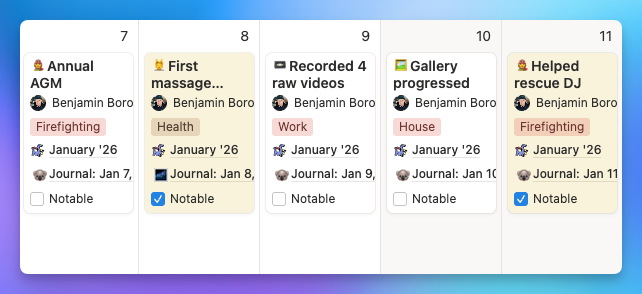
Our Highlights database, with conditional color highlighting key moments I want to consider later.
If you want a habit to keep up, develop a review habit. Add startup and shutdown routines to your journal. Document your rituals. Do you have an idea what an “ideal day” looks like for you? Write it down.
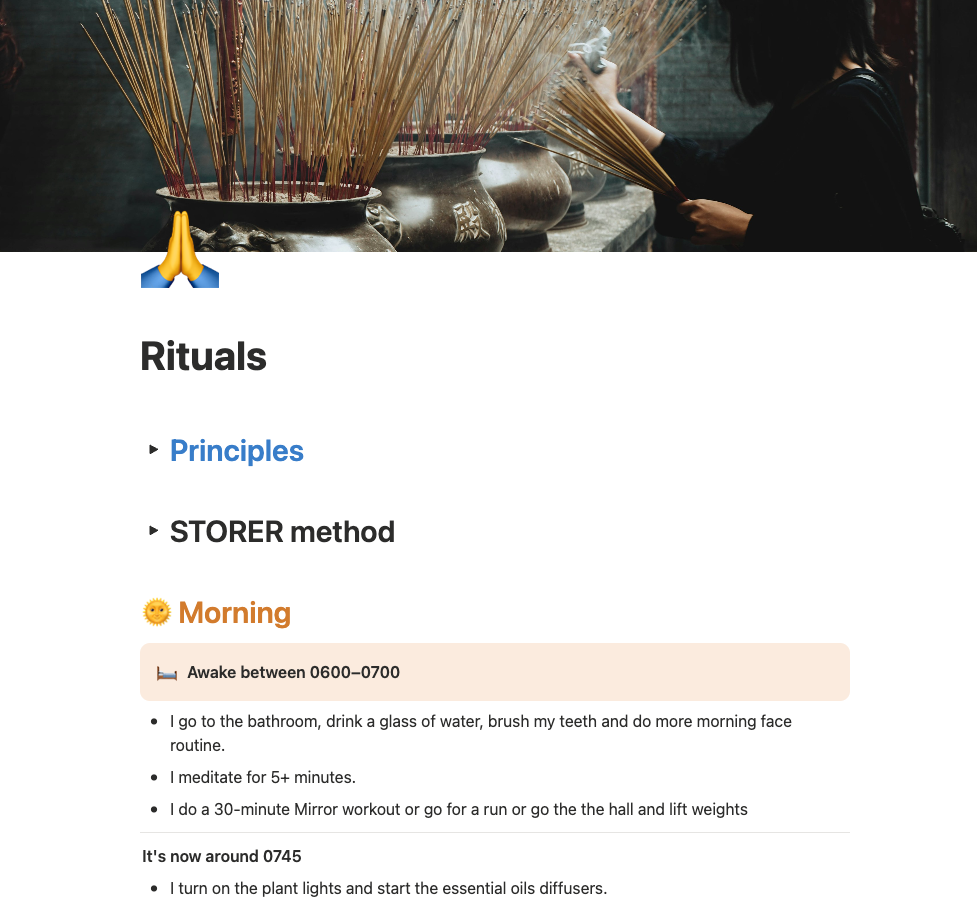
I regularly update my Rituals page, which is an idealized version of a day in my life. I have a database of my Principles which drive my actions. What would I need to do, change, accept to make this real?
Track gratitude: Who helped you today? Who did you help today?
Build on the review practice. Add a new database for weekly reviews. After 4 weeks of this practice, perhaps add a new database for monthly reviews. Sit with this for 3–6 months adding nothing else. How can you leverage Notion’s block-based design to add variance and personal interest to your pages?
Try something new every day. It’s not important that it solves a need, just that you observe the impact to your operation.
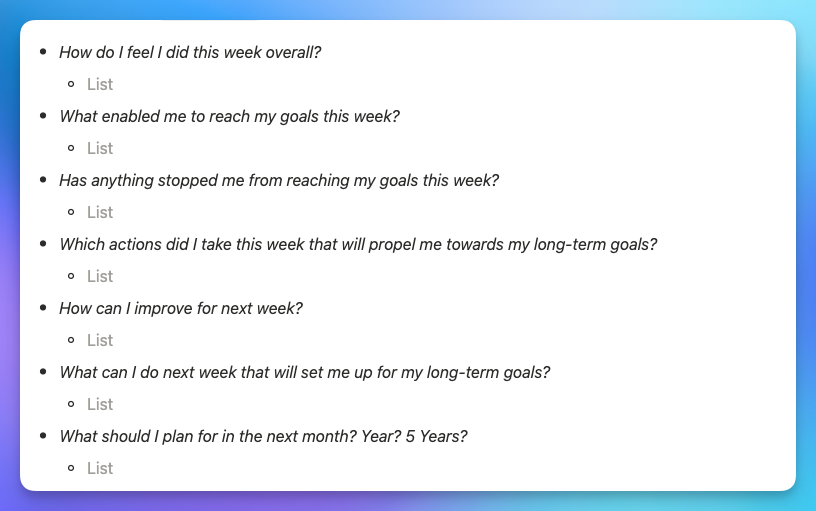
A selection of reflections in my weekly review template.
At 6–12 months, build a dashboard and use linked views of your data sources to create an annual review. Might you publish it? Phew, that’s quite vulnerable. But what might you discover in the rawness of your less observable identities?
This is how you sit with overwhelm: by sitting with the problem for a long time. Stewing in it. Not desiring going any further than observation.
Can you resist the pull of progress and focus on betterment instead?
There’s a powerful religion in observance of progress, disconnected from nature. Progress is fickle and impatient, however; the bearers of its standards addicts. It must be fed and is insatiable—its gaping maw the event horizon of endless responsibility known as productivity.
But progress can be resisted. You can focus on building systems that help you stay in the mode of being rather than doing. You can build the utilities and systems that better you and keep you grounded in your experience, avoiding the acceleration and the whiplash of pacing technical progress.
Asking ourselves: who does this progress serve?